Monday, November 14, 2016

A Little Life Philosophy - Idioms in Context


Updated October 26, 2016.

Here is a short story about a simple life philosophy. Try reading the dialogue one time to understand the gist without using the idiom definitions. On your second reading, use the definitions to help you understand the text while learning new idioms. You'll find idiom definitions and a short quiz on some of the expressions at the end of the story. 

A Little Life Philosophy
Here are some thoughts on how to live a reasonably balanced life. These aren't any great insights, just everyday thoughts on how to be satisfied and relatively happy despite the curves that life throws us at times. First and foremost, it's important to find people that you like. That means finding someone who won't make you feel put upon. That's truly a horrible feeling! It's also a good idea to find people who aren't going to press your buttons too much. Friends will kid around, but good friends will hit a happy medium between joking and respecting each other. On the topic of friends, it's a good idea to treat your friends like you'd like them to treat you.

It's simple, but put this advice into practice and you'll be surprised at what great friends you find. 
In these modern times, we all enjoy having the latest, greatest products such as smart phones and stylish clothing. Just remember that all that glitters is not gold. I find it helpful to always keep the presence of mind about me when I'm shopping. Rather than fall into the trap of using your credit card too much, wait a day or two. Try this trick the next time your heart skips a beat because some beautiful piece of technology calls to you from the shop window. Once you've got this technique under your belt, you'd be surprised how much you will save.

Finally, when things do go wrong be careful and take it slowly. Take a few deep breaths, regain your composure, and then act. Unfortunately, we all get the short end of the stick at times. When this happens, know that life doesn't turn on a dime. Ups and downs are all part of the puzzle that is life. Taking this approach will make problems run like water off a duck's back. You'll need to straighten things out from time to time, but you'll know it's not the end of the world. Of course, it's also a good idea to cross bridges when you come to them rather than worry too much about everything that could go wrong in life!

Idioms and Expressions
all that glitters is not gold = not everything that looks good is good
cross a bridge when one comes to it = deal with a situation when it happens, used when explaining that one shouldn't worry too much about possible problems
fall into the trap = do something that something wants you to do in order to take advantage of you
feel put-upon = feel like someone is forcing your to do something you don't want to do
get something under one's belt = experience something
get the short end of the stick = lose in an arrangement of some sort, receive the smallest portion
have the heart skip a beat = be surprised by something
hit a happy medium = find balance between extremes
kid around = have fun, joke
presence of mind = the ability to calmly think about a situation and make the best decision rather than act on emotion
push someone's buttons = know exactly what to say to anger another person
put something into practice = do something that you want to become a habit, often used when following advice
regain one's composure = find balance after having becoming very emotional (anger, sadness, spite, etc.)
run like water off a duck's back = not bother or affect someone
straighten something out = resolve a problem
throw someone a curve = do something that surprises someone, often used when negative events happen
turn on a dime = change without hesitation

Idiom and Expression Quiz
Check your understanding of the new idioms and expressions with this quiz.
  1. Jennifer feels ___________ by her boss at work. She's always asking her to stay and work overtime. 
  2. I wish you wouldn't ________________. This is serous business for serious people!
  3. Luckily, Tom had the _________________ to bring all the equipment despite the crazy rush to leave this morning.
  4. I'd like to get a climb of Mt. Hood _______________. It must be an amazing adventure.
  5. I'm trying to put my philosophy __________________ every day. It's not always easy!
  6. I wish you would stop pushing my _________________. I don't want to argue with you.
  7. I've hit a ___________________ between work and free time.
  8. My heart skipped __________ when I heart the news about their marriage.
  9. He fell into _____________ when he agreed to give her lessons for free.
  10. I'm afraid you've gotten ___________________________. Next time will be better!
Answers
  1. put-upon
  2. kid around
  3. presence of mind
  4. under my belt
  5. into practice
  6. buttons
  7. happy medium
  8. a beat
  9. a trap
  10. the short end of the stick

Friday, September 30, 2016

Idioms & Expressions with ‘Head’


The following idioms and expressions use the noun 'head'. Each idiom or expression has a definition and two example sentences to help understanding of these common idiomatic expressions with 'head'. 

able to do something standing on one's head -> do something very easily and without effort
He's able to count backward standing on his head.
Don't worry about that. I can do it standing on my head.


bang your head against a brick wall -> do something without any chance of it succeeding
I've been banging my head against a brick wall when it comes to finding a job.
Trying to convince Kevin is like banging your head against a brick wall.


beat something into someone's head -> teach someone something by repeating it over and over again
Sometimes you just need to beat grammar into your head.
My father beat the importance of kindness into my head.


bite someone's head off -> criticize someone strongly
Tim bit my head off last night at the party.
Don't bit my head off just because I made a mistake.


bring something to a head -> cause a crisis to happen
We need to bring the situation to a head to get a resolution.
The immigration situation brought the political crisis to a head.


bury one's head in the sand -> ignore something completely
You're going to have to face the situation and not bury your head in the sand.
He chose to bury his head in the sand and not confront her.


can't make heads or tails out of something -> not be able to understand something
I hate to admit that I can't make heads or tails out of this math problem.
The politicians can't make heads or tails out of the current employment crisis. 


drum something into someone's head -> repeat over and over until someone learns something
I had to drum German grammar into my head for two years before I could speak the language.
I suggest you drum this into your head for the test next week.


fall head over heels in love -> fall deeply in love
She fell head over heals in love with Tom.
Have you ever fallen head over heels in love?


from head to toe -> dressed or covered in something completely
He's dressed in blue from head to toe.
She's wearing lace from head to toe. 


get a head start on something -> begin doing something early
Let's get a head start on the report tomorrow.
She got a head start on her homework immediately after school.


get your head above water -> keep going in life despite many difficulties
If I can find a job I'll be able to get my head above water.
Study these pages and you'll get your head above water.


get someone or something out of one's head -> remove someone or something from your thoughts (often used in the negative)
I'm really upset that I can't get her out of my head.
She spent three years getting those experiences out of her head.


give someone a head's start -> let someone else begin before you in  a competition of some kind
I'll give you twenty minutes head's start.
Can you give me a head's start?


go over someone's head -> 1. not be able to understand something
I'm afraid the joke went over her head.
I'm afraid the situation goes over my head. 


go over someone's head -> 2. Talk to a higher authority
The clerk did not understand what I wanted so I had to go over her head and talk to the manager.
I could not get the salesman to stop badgering me so I went over his head and spoke to the supervisor.

go to someone's head -> make someone feel better than others
His good grades went to his head.
Don't let your success go to your head. Stay humble.


have a good head on your shoulders -> be intelligent
She's got a good head on her shoulders.
You can trust him because he's got a good head on his shoulders.


head someone or something off -> arrive before someone or something else
Let's head them off at the pass.
We need to head the problem off.


head strong -> Stubborn
My brother is so head strong, he won't listen to anybody.
There's no sense talking to her about it. She's way too head strong.

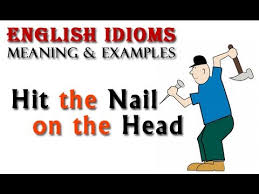
hit the nail on the head -> be exactly right about something
I think you hit the nail on the head.
His answer hit the nail on the head.


in over one's head -> do something that is too difficult for a person
I'm afraid Peter is in over his head with Mary.
Do you ever feel that your in over your head?


lose your head -> become nervous or angry
Don't lose your head over the situation.
She lost her head when he told her he wanted a divorce.


Source: Most of these come from an article on esl.about.com but I added in a couple more that were missing.

Wednesday, August 3, 2016

Three Cases of Repetitive Punctuation


In each of the sentences below, the number of commas is excessive, which can obscure comprehension because the reader is distracted from effortlessly recognizing the syntactical structure of the statement. Discussion and a revision follows each example.

1. The next step is to escalate the issue to the executive management, including the CEO, and, through appropriate channels, the board of directors.
When repetition of commas or other punctuation marks within a sentence is overbearing, recast the sentence or, as shown here, change punctuation marks to reduce the number of identical occurrences: “The next step is to escalate the issue to the executive management (including the CEO) and, through appropriate channels, the board of directors.”

2. They will need to exercise their own judgment when considering whether a lower threshold is appropriate for a portion, or all, of their customers, which, again, may lead to inconsistent practices across the industry.
If a word or phrase signals an abrupt or unexpected shift in a sentence, a dash is likely a more appropriate substitute when too many commas burden a sentence: “They will need to exercise their own judgment when considering whether a lower threshold is appropriate for a portion, or all, of their customers—which, again, may lead to inconsistent practices across the industry.”

3. The entrance of nontraditional competitors, such as fintech, or financial technology, companies into the financial services industry, is driving this recent evolution.
The primary parenthesis in this sentence is misidentified: The phrase “or financial technology” is inserted into the parenthetical phrase “such as fintech companies,” which expands on the main clause “The entrance of nontraditional competitors into the financial services industry is driving this recent evolution.” The parenthesis should therefore end at companies, not industry: “The entrance of nontraditional competitors, such as fintech, or financial technology, companies, into the financial services industry is driving this recent evolution.”

However, the proximity of punctuation here is oppressive, and punctuation isn’t always required when additional information is inserted into a sentence; the statement is equally intelligible as punctuated here: “The entrance of nontraditional competitors such as fintech, or financial technology, companies into the financial services industry is driving this recent evolution.”

FYI: In a list of things, the last item is usually preceded by an ‘and’.  American English puts a comma before the ‘and’.  British English does not…as in the following:

AmerEng: I went to the super market and bought an apple, a banana, and a carrot.

BritEng:  I went to the super market and bought an apple, a banana and a carrot.

Thursday, July 28, 2016

Small Talk - Lesson Plan


The ability to make small talk comfortably is one of the most requested skills of almost any English student. This is especially true for business English learners, but applies to all. The function of small talk is the same the world over. However, which topics are appropriate for small talk can vary from culture to culture. This lesson plan focuses on helping students develop their small talk skills, while also addressing the issue of appropriate subjects. Difficulties in small talk skills can arise from a number of factors including hesitancy in grammar and comprehension skills, lack of topic specific vocabulary and a general lack of confidence. These topics can also lead to more involved conversation lessons to get at the heart of the matter, so make sure to give students ample room to delve into the subjects if they seem particularly interested.

Aim: Improving 'small talk' skills

Activity: Discussion of appropriate small talk subjects followed by a game to be played in small groups

Level: Intermediate to Advanced

Outline:
  • Write 'Small Talk' on the board. Ask students to brainstorm as a class to define small talk. Write examples on the board.
  • Discuss the importance of small talk skills with the class. (you may want to refer to the making small talk page for ideas)
  • Divide students into groups of 3 - 5.
  • Give students the small talk work sheet. Ask them to complete the first section: Small Talk - Appropriate?.
  • Once students have discussed the various situations, solicit responses on the various subjects from the class as a whole. Make sure to ask for examples of comments on appropriate subjects and explanations for those topics which students feel are not appropriate. Feel free to let students debate the issue (thus developing their conversational skills!), as some subjects are sure to be controversial.
  • Have students get back into their groups and play the small talk game. Circulate around the room helping the students when they run into difficulties.
  • Take notes on subjects that students find difficult and brainstorm on appropriate comments for those subjects after the game has finished.

Small Talk - Appropriate?

Which topics are appropriate for small talk discussions? For those topics which are appropriate, think of one interesting comment to make when the teacher calls on you. For those topics which are not appropriate, be able to explain why you believe they are not appropriate for small talk.
  • The latest films
  • The One True Path to Eternal Life
  • The local basketball team
  • Cars
  • A product you would like to sell to everyone
  • The Death Penalty
  • Your home town
  • How much you make
  • Your last holiday
  • Your favorite movie-star
  • The correct political party
  • The weather
  • Gardening
  • Your health problems
  • Your family

Small Talk - Socially Mixing

Play this game quickly in small groups. Throw one die to move forward from one subject to the next. When you get to the end, return to the beginning to start again. You have thirty seconds to begin making a comment about the suggested subject. If you can not, you lose your turn!
  • Your best friend
  • The last film you saw
  • Pets
  • Rock and roll
  • A magazine
  • Learning a language
  • Playing tennis
  • Your current job
  • An interesting excursion nearby
  • The Internet
  • Marilyn Monroe
  • Keeping healthy
  • Human cloning
  • Your favorite food
  • Finding a job in your country
  • The last book you read
  • Your worst holiday
  • Something you've never done, but would like to do
  • Teachers - what you like
  • Teachers - what you don't like